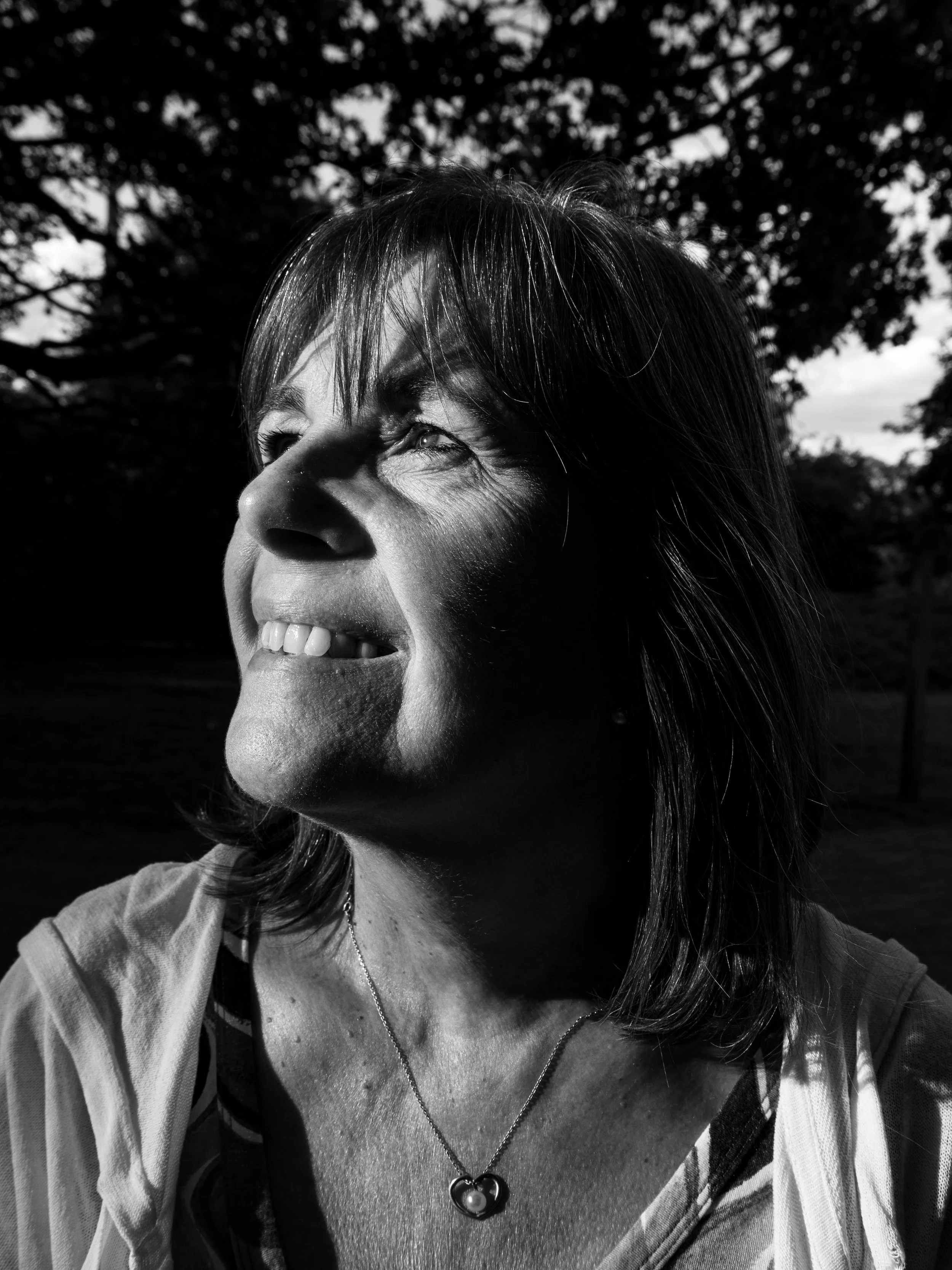
My name is Patricia Wennell.
I am from and live in Southeast London, UK. I kept a journal throughout my many years of therapy and eventually published a memoir ‘Because It Didn’t Stop When It Ended’ using my poetry and prose to share the story of how therapy helped me to work through the devastating impact of abuse in childhood.
I met Lee at the book launch of another person who was abused in childhood and learned about Victorious Voices and his photographic portraits. I knew I wanted to have mine taken. I use writing to express myself, while Lee’s photographic portraits offer another form of communication: giving visibility to experiences of abuse that too often remain unspoken. I felt it would be another way to express myself, in the hope that sharing my experiences would help others. I would say I am recovering; I know joy and can see colour.
During childhood, I experienced neglect, physical violence and psychological abuse from my mother, as well as sexual abuse by a family friend. The impact left me consumed with feelings of shame and badness. I stopped attending school, had nothing in common with other children and didn’t feel I belonged anywhere. I hid behind a persona of being okay for many years but I wasn’t okay. I hated myself. Having a photo taken was out of the question; I believed others would be able to see the badness that I tried so hard to hide.
It took many years of therapy before I was able to place the shame and badness with those who had abused me and learn to stop hating myself. I am still learning to value myself, but I live more lightly now. The trauma remains within me, but so does a genuine sense of goodness that reaches my eyes and my smile.
I first shared my experience of abuse after someone close to me disclosed what they were going through. Their disclosure triggered a whirlwind of flashbacks and distress for me. I read The Courage to Heal by Ellen Bass and Laura Davis, along with other self-help publications, but I could not afford therapy. A few years later, I received some therapy, but it was not until I was 47 that a rare opportunity to receive free, long-term, trauma-informed therapy through the NHS became available. Through the Women’s Service, I received psychotherapy specifically for women who had experienced non-recent child sexual abuse, and it was life-changing. Over six years, I had five years of therapy with an amazing therapist, which enabled me to move from existing in the grey to living with joy and colour.
I write whenever I feel emotionally overwhelmed. A notepad and pen, my iPhone and laptop are the holders of my most private thoughts, feelings and memories. They eventually go into my journal and I drew on some of those journal entries when publishing my memoir and, more recently, a book of poetry and art ‘Don’t Pass it on – Pay it forward’. I wanted to share my experience to help others, to bring them hope and reduce the isolation that many survivors experience
They say it takes a village to raise a child, and in my view, it takes a very special kind of village to support a survivor of childhood abuse through their journey of recovering. There came a day when hiding was no longer an option. Although I was ready to work through the abuse, the rawness of that pain cut through me like a rusty saw, taking away my breath and bringing me to my knees. I didn’t think I could survive it and believed I would fall. My ‘special kind of village’—my network of support—was an essential addition to the help provided by my amazing therapist.
I found the trauma-informed relational psychotherapy I received especially helpful. I felt held and supported by my therapist, and the relational approach created a sense of ‘being in it together’ rather than an ‘us and them’ dynamic. Becoming involved with survivor organisations was another valuable source of support. I also read widely on the subject, including:
Trauma and Recovery by Judith Herman
Truth and Repair by Judith Herman
The Body Keeps the Score by Bessel van der Kolk
The Flying Child: A Cautionary Fairy Tale for Adults by Sophie Olson
The Suicidal Therapist: Confessions of a Wounded Healer by Liz Bentley.
I chose a career in social work which gave me a home for the energy and passion I had for helping others. It also enabled me to maintain my persona of being ok while having a rewarding career. Therapy and writing have been equally important in helping me develop an identity of my own, rather than one imposed on me by those who abused me. My support network has also played an important part. My self-care practices include walking in nature, swimming, me time and spending time with family and friends.
Having children—and wanting to be the best parent I could be—was the most important turning point for me. I knew there was more to life than how I felt about myself. When my children grew up and needed me less, I realised it was time to work on myself and my relationship with my life partner. It was the turning point for me and eventually resulted in me taking a career break to focus on aging relatives, my adult children, grandchildren and publishing my first book.
For me, feeling isolated and alone was the hardest part of being in therapy. Developing a network of support is as important as the chosen therapy or therapeutic service. At the suggestion of my second therapist, I joined Survivors Voices. I was supported to co-author a paper advocating for NHS Personal Health Budgets to enable adult survivors of childhood abuse to access trauma-informed therapy or other therapeutic services. I was also introduced to the Non-Recent Child Sexual Abuse Network and took part in training for the Tavistock and Portman, led by Laura Salter. I am also a member of the Lived Experience Advisory Group for the Recovery Histories Research Project, led by Ruth Beecher at Birkbeck, University of London. These are all new members of my special village, and we support one another. I would recommend finding something that works for you.
I don’t believe I have anything to forgive myself for. I was a small child and the adults who abused me were responsible for their own actions. I don’t think it is for me to forgive anyone for the choices they made to abuse me. I hate what they did, but I don’t hate them. More importantly, I no longer hate myself. I love and care for myself, and that is what matters most.
To other CSA survivors on their path to healing, I would say: be kind and gentle with yourself, especially to your inner child, the little girl or boy who was abused. What happened was not their fault then, and it is not your fault now. Drawing on Carolyn Spring’s metaphor in Trauma and the Bears, don’t give all your honey to the bears.
Don’t give the best of yourself and all your time to an employer or relationship. Save some of your energy, love and care for yourself. Maintain a healthy work–life balance and allow yourself to come first. It isn’t selfish; it is healthy to love and nurture yourself in the way you should have been nurtured as a child.
Read or listen to books that relate to your experiences. Find your own form of expression: paint, sketch, sculpt, take photographs, write, learn to play an instrument or sing.
Find a therapist or therapeutic service that works for you. The British Association for Counselling and Psychotherapy (BACP) and the UK Council for Psychotherapy (UKCP) provide online directories of registered therapists.
If you are interested in a Personal Health Budget, ask your NHS care team or local Integrated Care Board whether you are eligible and whether a budget could support agreed therapeutic care. Childhood abuse can have lasting physical, emotional and psychological effects, and survivors should be able to access appropriate NHS support.