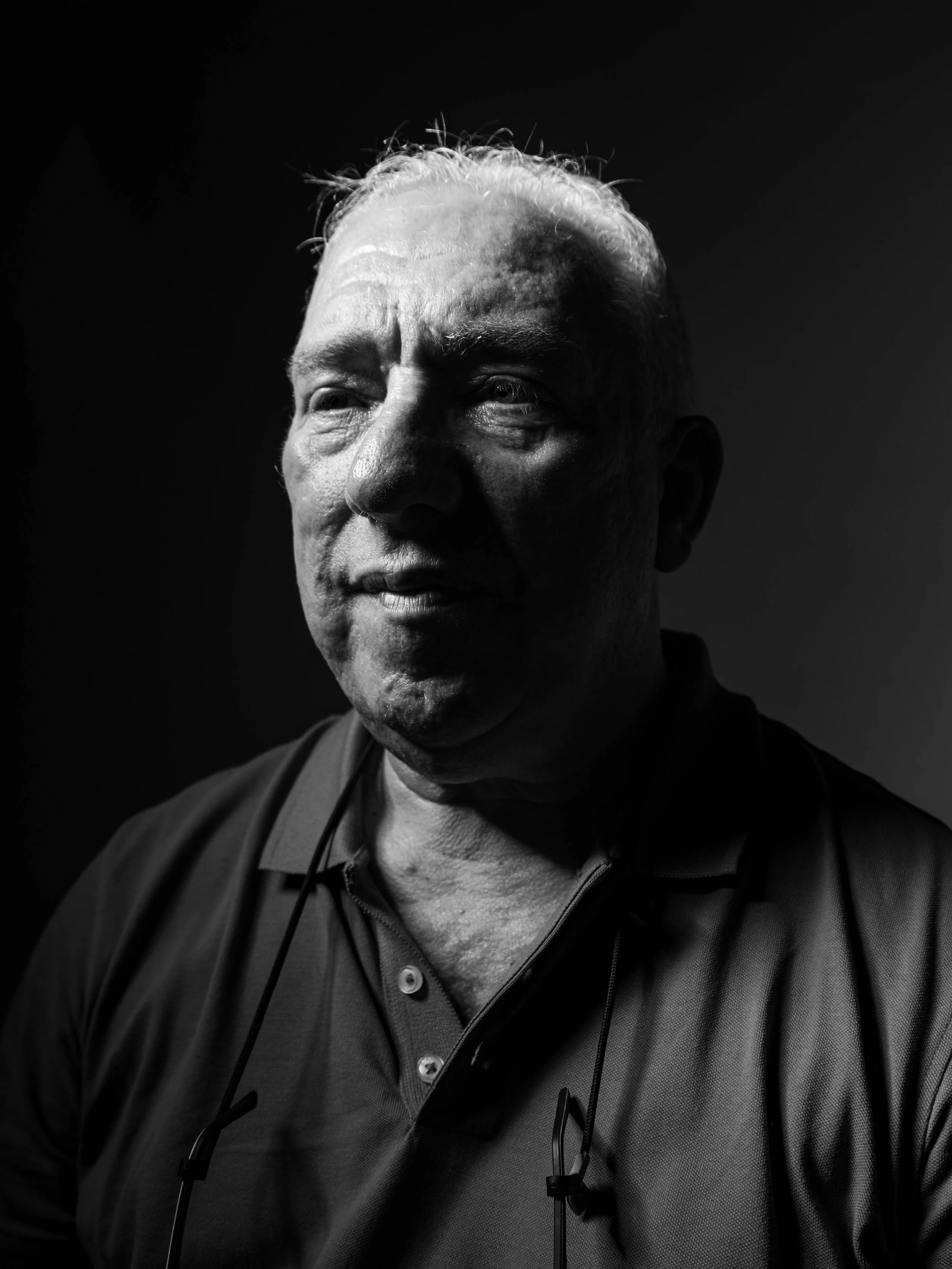
My name is Rob Balfour.
I was born in Seacombe, Wallasey, and now live in Yorkshire. I wanted to take part in Victorious Voices because I was drawn to the project’s aim of giving survivors of childhood sexual abuse (CSA) not only a voice but also a face.
I believe it is vitally important that we move beyond expecting survivors to ‘break their silence’, often in contexts where they are not properly supported. Instead, we should challenge society’s cultural silencing of survivors, so that disclosure does not have to become a revolutionary act.
For ten years from the age of six, I experienced four male sexual abusers who would now be categorised as groomers, and one female aged around 14 who introduced me to male-female sex when I was around eight years old. In 2015, I brought the first of those four men to justice. Clifford Jones is a man with a long history of sexually abusing children. He was sentenced to 18 months’ imprisonment under the legislation applicable to offences committed in the 1960s. The police declined to investigate two other men, but my allegations were recorded as credible.
The final abuser, John Allen, who ran one of the biggest children’s home businesses in the UK at the time – The Bryn Alyn Community (Lost in Care, 2000) – was at the centre of a major inquiry run by the National Crime Agency. This was Operation Pallial and in 2014, he was sentenced to life imprisonment, with a minimum term of 11 years for the sexual crimes committed against me and 13 other boys.
The catalyst for sharing my story was the publication of Lost in Care, the report of the North Wales children’s homes inquiry, in February 2000. On the day it was published, I publicly disclosed the sexual violence inflicted on me as a child.
My first step towards healing was contacting my GP to request counselling. Becoming more aware of my coping strategies—and moving beyond those that had not helped me—enabled me to navigate the healing process. I was fortunate to have a good therapist, a supportive professional network, and supportive family and friends. Simply being seen and validated as someone greater than the abuse inflicted on me changed my life. I cultivated self-care by maintaining a broad perspective, being open about recovery and, above all, being kind to myself.
Reclaiming my identity and agency has been—and remains—a journey. For example, I recently returned to my childhood name, Rob. I had called myself Bob since leaving the children’s home, using a different name as a way to escape into a new life. I am now very happy to have reclaimed my childhood name. Connecting with people, gaining knowledge, mattering to others and to myself, and understanding why that sense of mattering is so important have all been central to my recovery.
The road to healing has not been smooth. In the past I have been triggered by people who claimed to be healers or to have recovered but were far from being so, sometimes delaying my journey. Nevertheless, I continued, learning to recognise authentic people who offer hope and kindness.
Even as a child, I was never a hater. I was angry about what had been done to me, but I never hated even my abusers. It is not for me to hate people who harm others. I choose not to become like them.
To help others, I would like to share three pieces of advice that I was once given and have found to be true:
Work on your own stuff
Work on your own stuff
Work on your own stuff
I would add a fourth: kindness is a superpower.
